Mascagni.org — The most comprehensive online resource about Pietro Mascagni.
Mascagni in San Francisco (1903)
Seven triumphant weeks by the Golden Gate at the close of Mascagni’s turbulent 1902–1903 North American tour
1. From Tour Disaster to Golden Gate Triumph
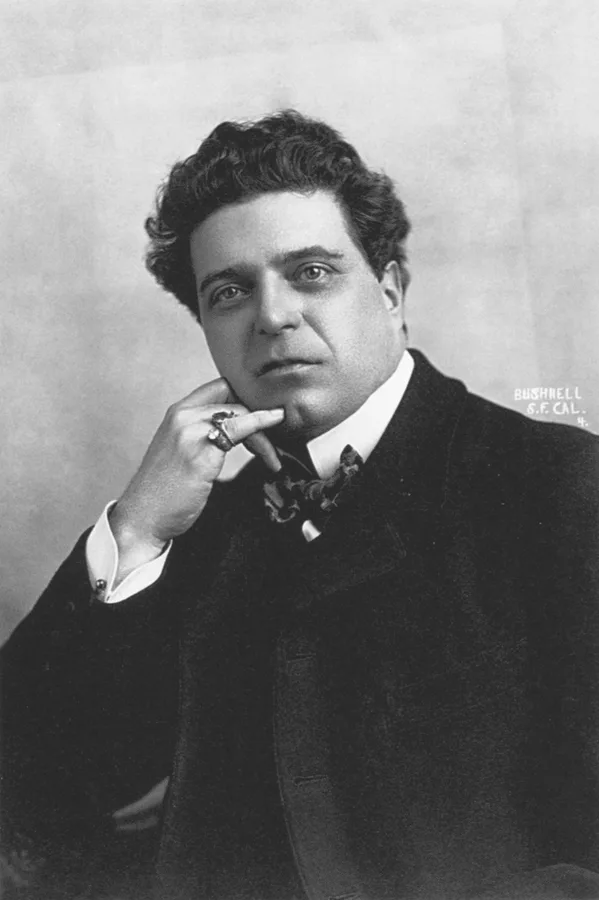
Pietro Mascagni in San Francisco (Bushnell Studio, Feb.–Mar. 1903)
When Pietro Mascagni stepped off the train in San Francisco with his wife Lina on the morning of
February 7, 1903, his much-publicized North American tour appeared to have ended in ruin.
Hired the previous summer for a fifteen-week engagement by the New York impresarios Aubrey and Henry Mittenthal,
Mascagni had endured chaotic rehearsals, an orchestral strike, a brief arrest in Boston over contractual claims
(reported across Italy), and fresh litigation in Chicago, where he paid
the remaining Italian musicians’ passage home out of his own pocket. Refusing to leave the United States until his
name was cleared in court, he accepted an invitation from enterprising San Francisco manager
Will L. Greenbaum.
What had been envisioned as a three-week visit blossomed into a seven-week artistic love affair that local critics
dubbed both the “Mascagni season” and “Mascagni-madness.” Conducting hastily assembled local orchestras and
choruses entirely from memory at the Alhambra Theater, Mechanics’ Pavilion, and the Tivoli Opera-House, Mascagni
won unanimous acclaim not only for Cavalleria Rusticana, Guglielmo Ratcliff, The Eternal City,
and the Hymn to the Sun from Iris, but also for his readings of Tchaikovsky, Wagner, Rossini,
Goldmark, Beethoven, and Chopin. Deeply moved by the city’s warmth, he composed the signed piano miniature
Un pensiero a San Francisco on February 20, 1903, and closed his American
journey conducting a benefit for San Francisco’s Verdi Monument before returning to Italy vindicated.
Throughout Mascagni’s stay, San Francisco newspapers — led by W. R. Hearst’s San Francisco Examiner and the
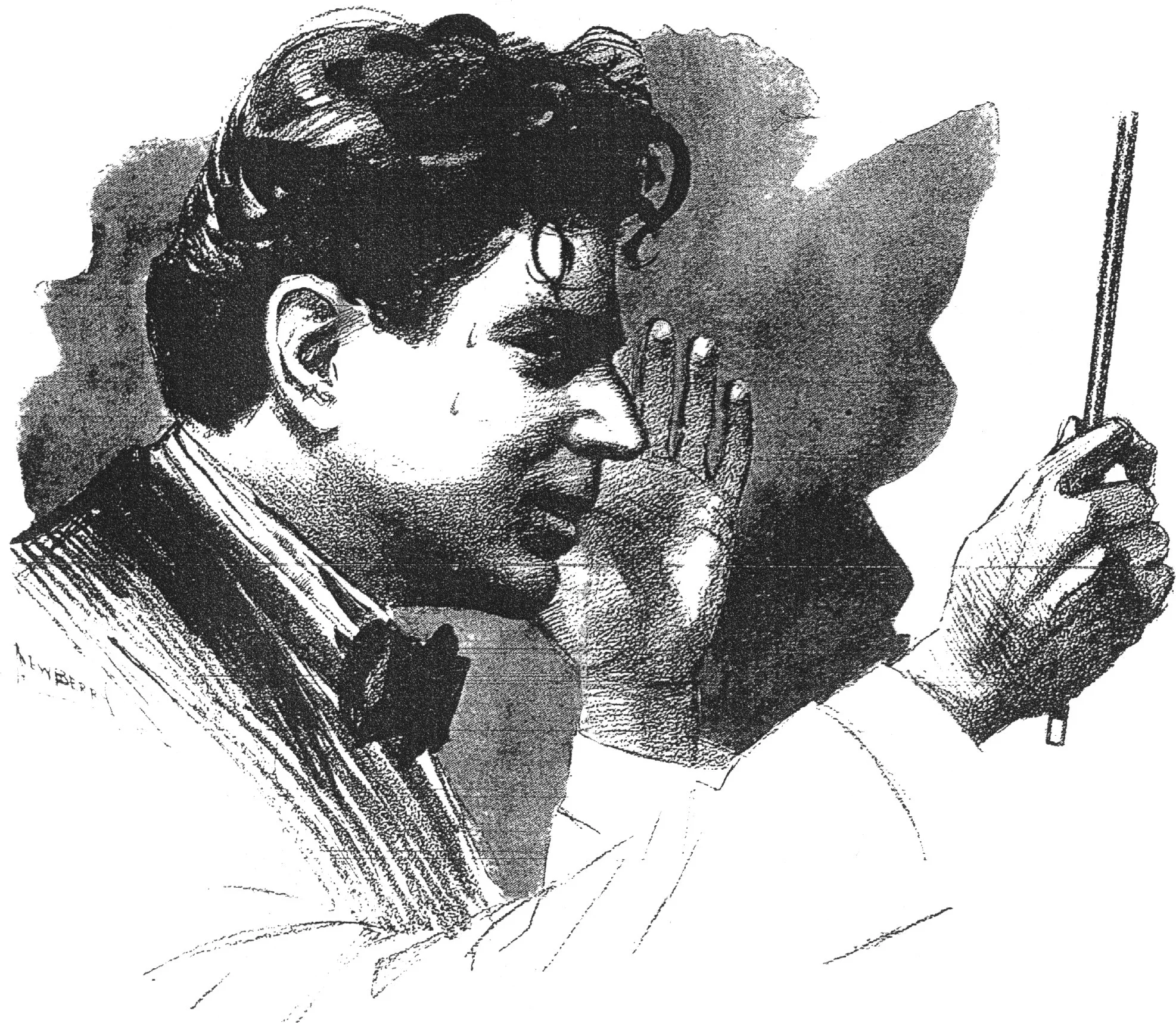
San Francisco Chronicle — devoted lavishly illustrated spreads to the composer’s rehearsals, podium gestures,
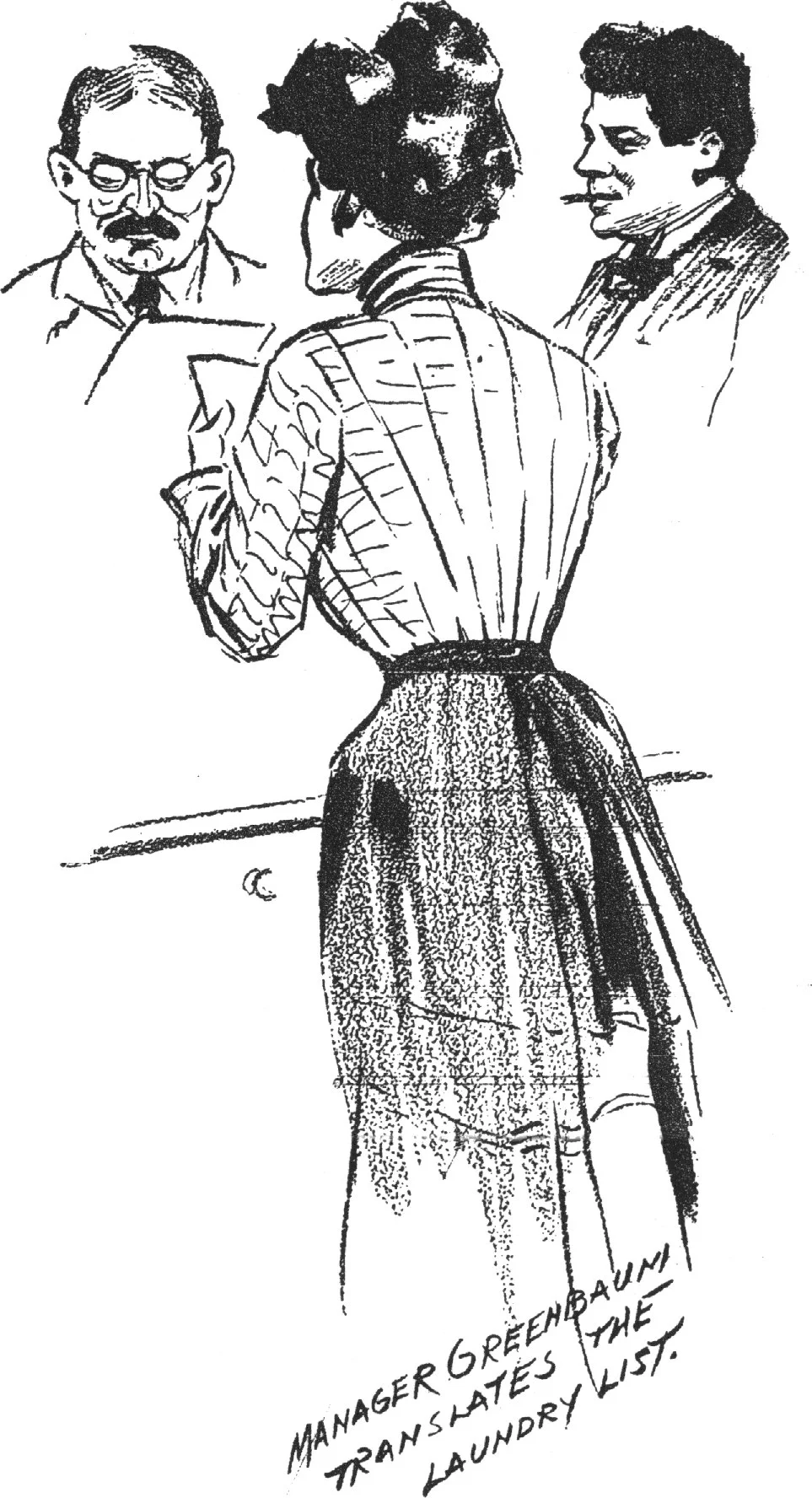
and everyday life in the city, right down to Manager Greenbaum translating Signora Mascagni’s laundry list. Select
any illustration or concert advertisement below to inspect the full scan.
Mascagni Conducting with the Baton
Drawing by Newberry · San Francisco Examiner, Feb. 1903
“Manager Greenbaum Translates the Laundry List”
Editorial sketch · San Francisco Examiner, Feb. 1903
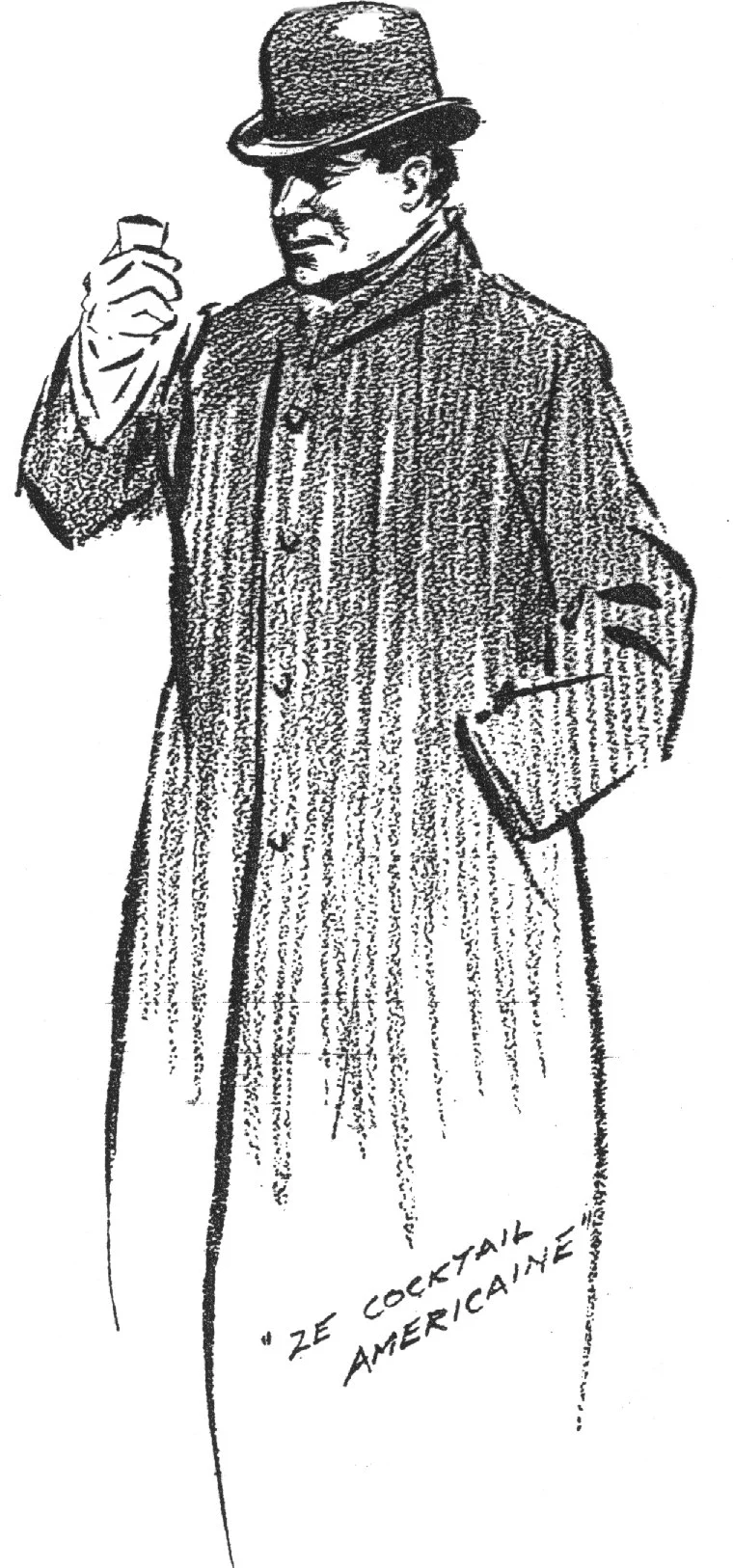
“Ze Cocktail Americaine”
Mascagni in bowler hat · San Francisco Examiner, Feb. 1903
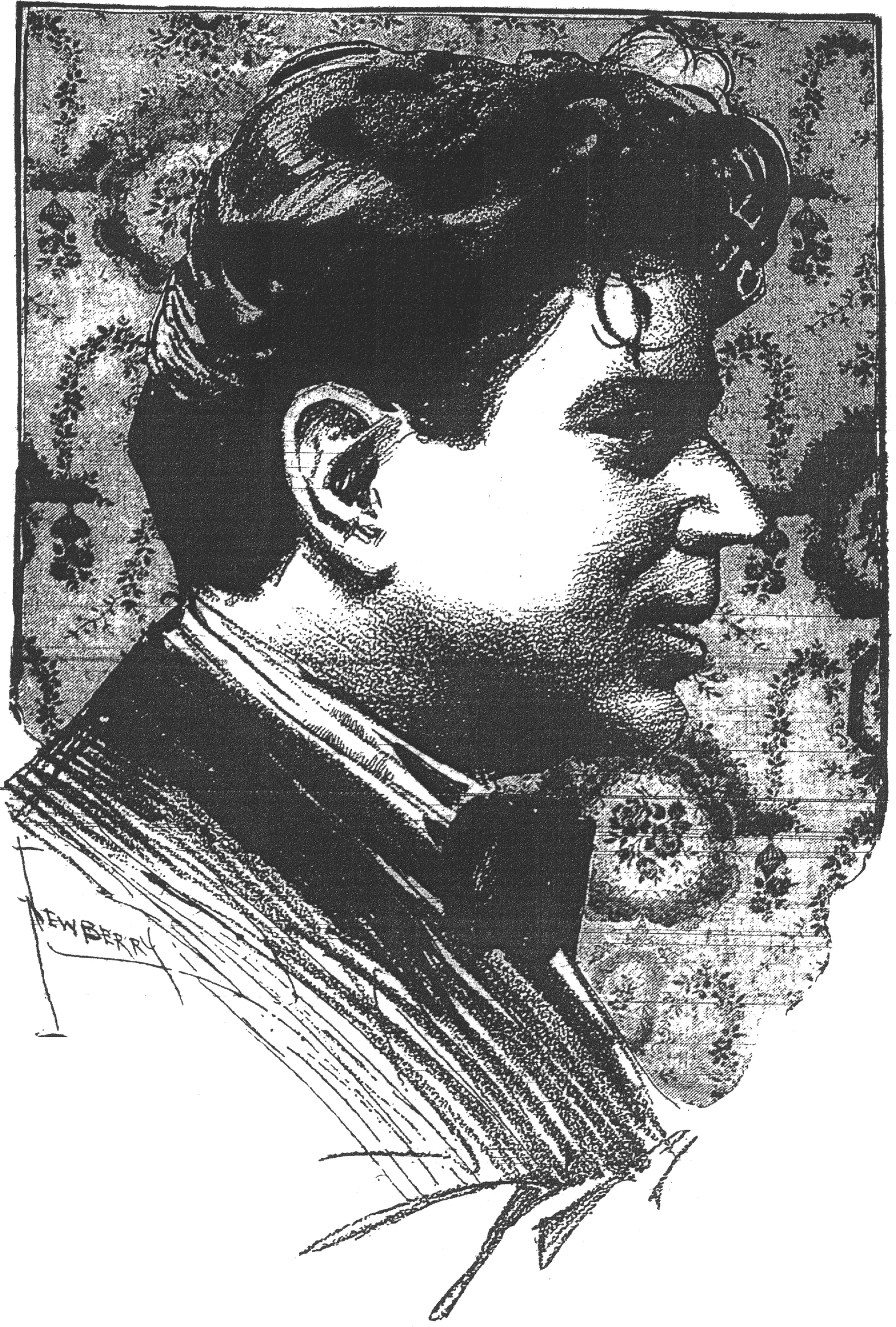
Portrait of Pietro Mascagni
Drawing by Newberry · San Francisco Examiner, Feb. 1903
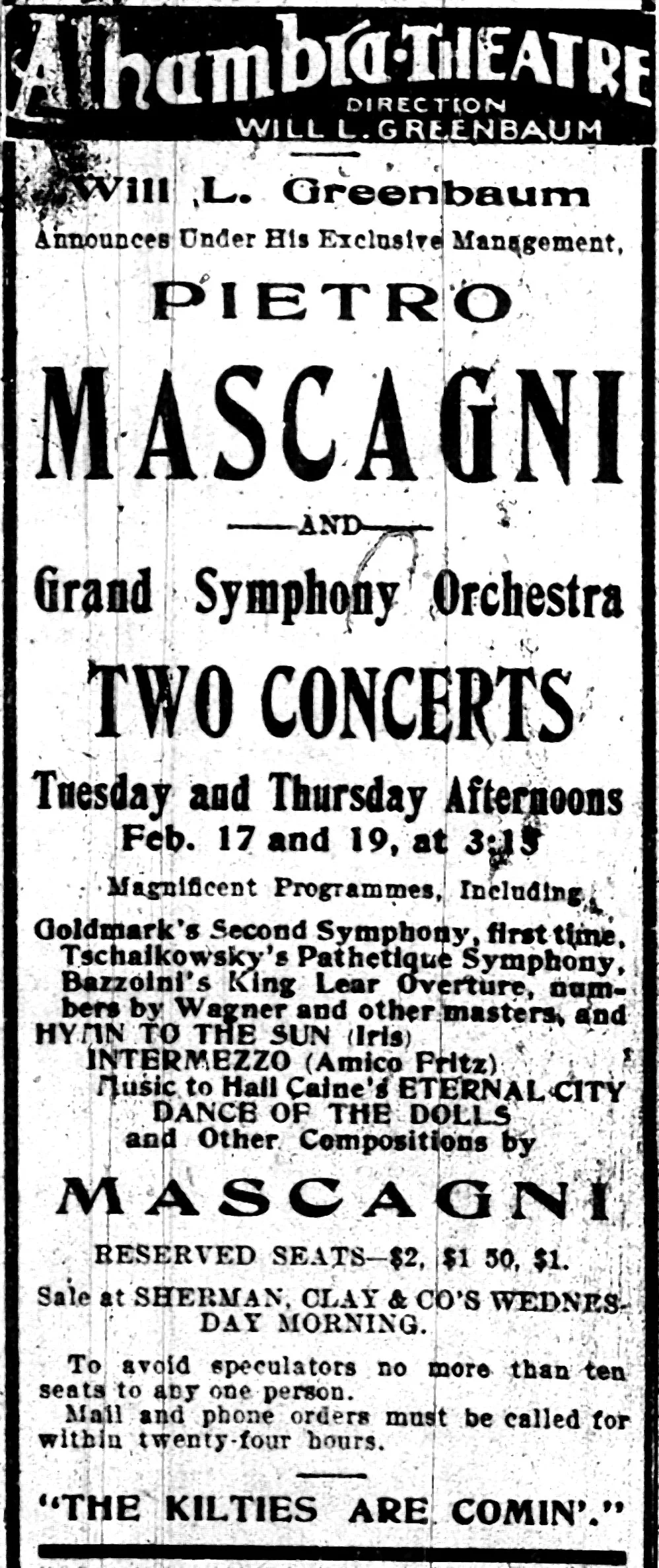
Alhambra Theatre Opening Announcement
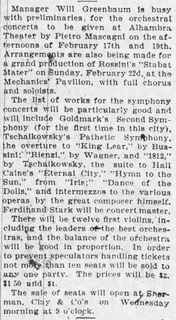
Will L. Greenbaum advertisement · San Francisco Chronicle, Feb. 8, 1903
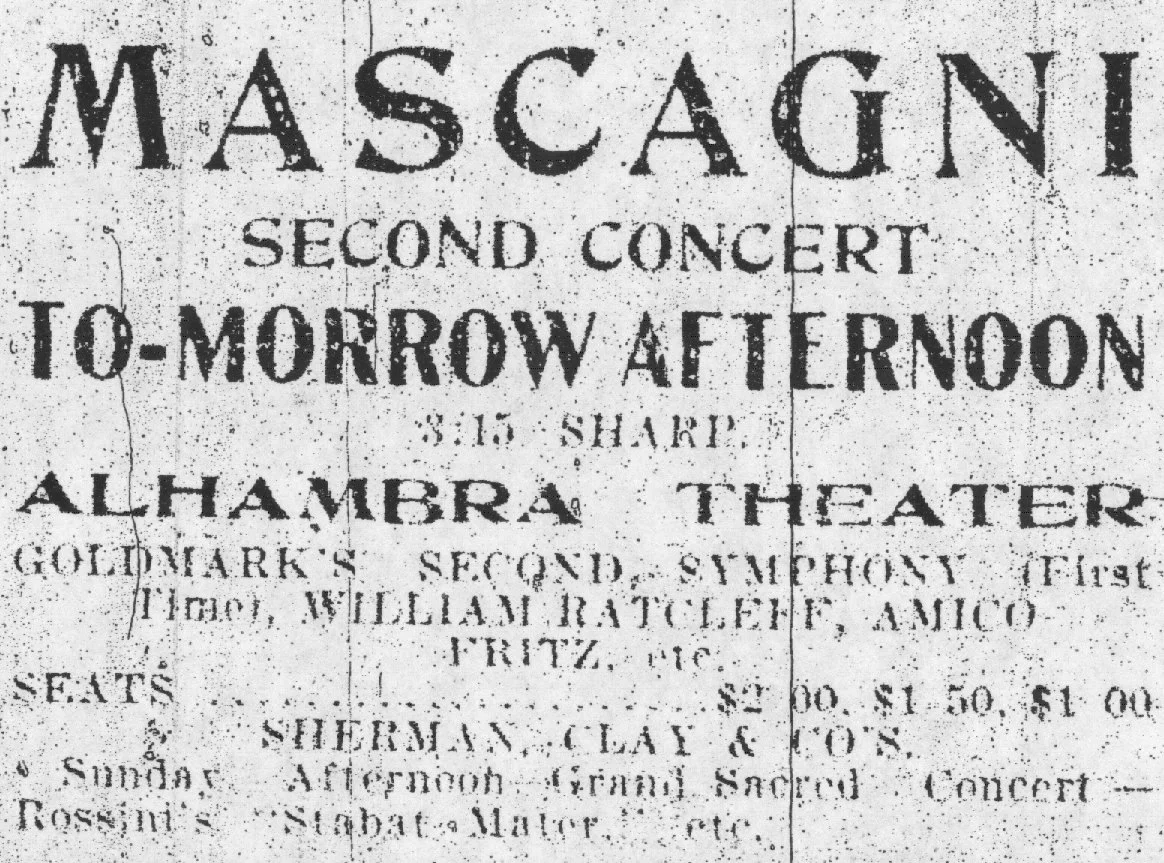
Second Alhambra Concert Advertisement
Goldmark’s Second Symphony, Ratcliff & Fritz · Feb. 18, 1903
3. February 1903 San Francisco Press Dispatches
Six contemporary articles, previews, and concert reviews from the San Francisco Examiner and
San Francisco Chronicle (February 8–23, 1903), transcribed in full and paired with their original microfilm
clippings and illustrations:
Composer Leaves His Troubles Behind Him During His Visit to California
San Francisco Examiner · February 8, 1903 · 1,380 words · Portrait Drawing
Published the morning after Mascagni’s arrival on February 7, this candid interview captures the composer laughing over a telegram inviting him to lead a military band in St. Louis and a $2,500-a-week Chicago vaudeville offer to play the Cavalleria Intermezzo twice daily on the piano, before offering his reflections on American musical life.
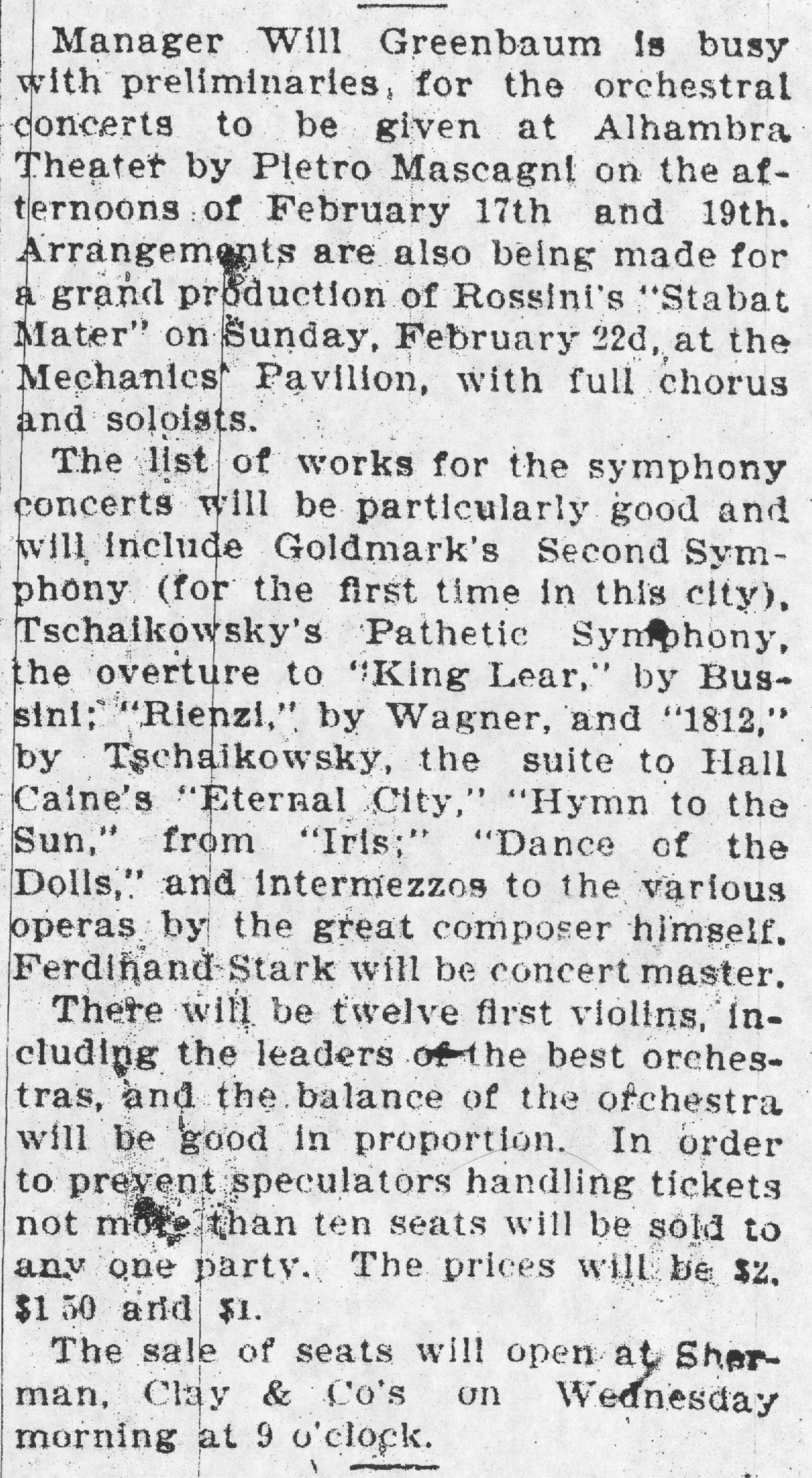
San Francisco Chronicle · February 8, 1903 · 220 words · Original Clipping
Announces Manager Will Greenbaum’s orchestral concerts at the Alhambra Theater (February 17 and 19) and Sunday Stabat Mater production, naming concertmaster Ferdinand Stark, twelve first violins, repertoire from Tchaikovsky and Goldmark to Iris and The Eternal City, and a ten-ticket limit to curb speculators.
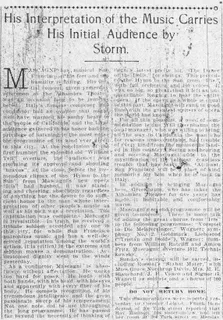
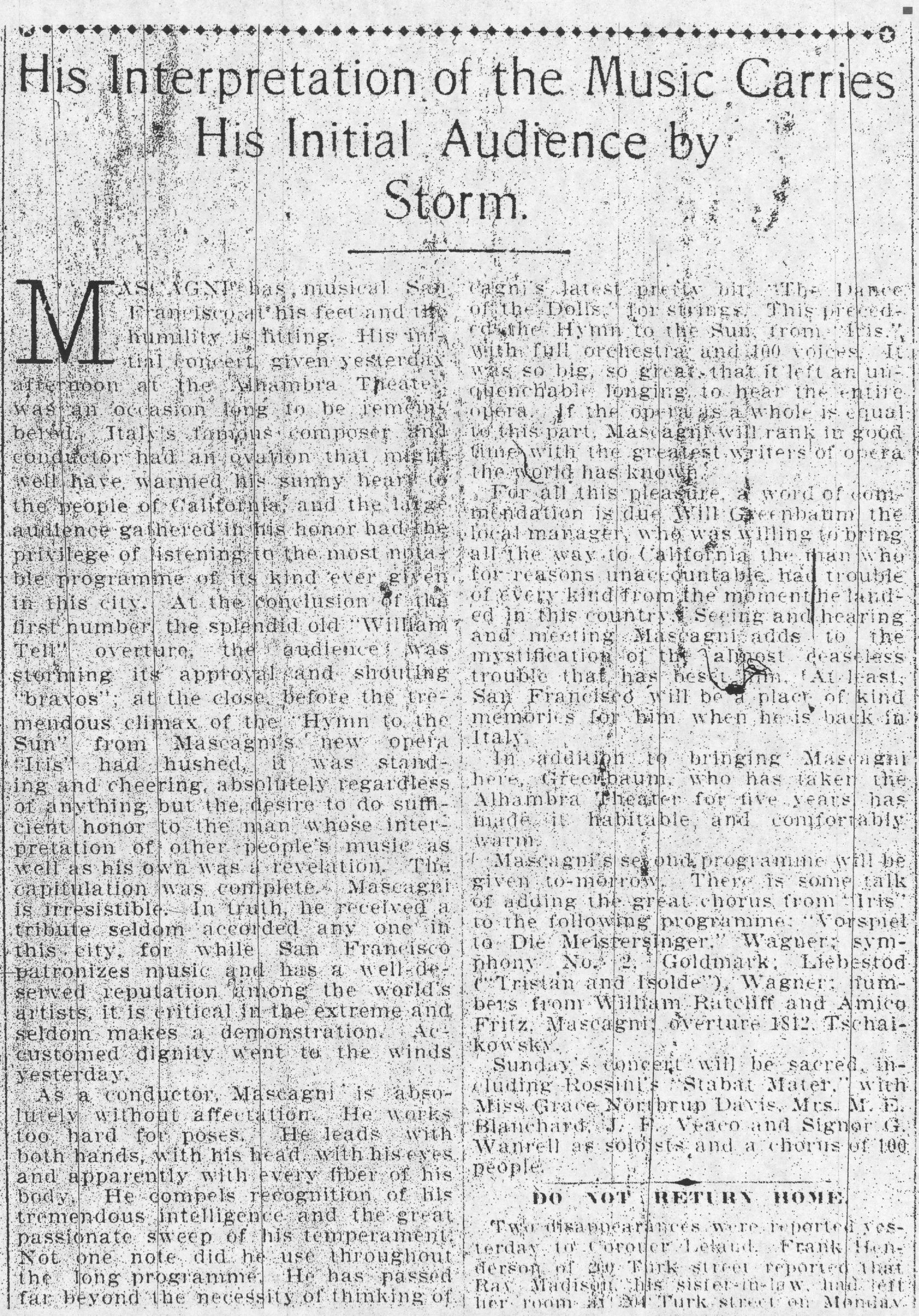
His Interpretation of the Music Carries His Initial Audience by Storm
San Francisco Chronicle · February 18, 1903 · 920 words · Original Clipping
Rave review of the opening February 17 matinee at the Alhambra Theater, marveling at Mascagni conducting the entire program without a score — from Rossini’s William Tell Overture and Tchaikovsky’s Pathétique Symphony to The Eternal City, The Dance of the Dolls, and the Hymn to the Sun from Iris with a 100-voice chorus.
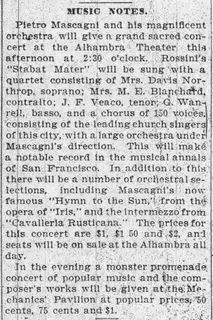
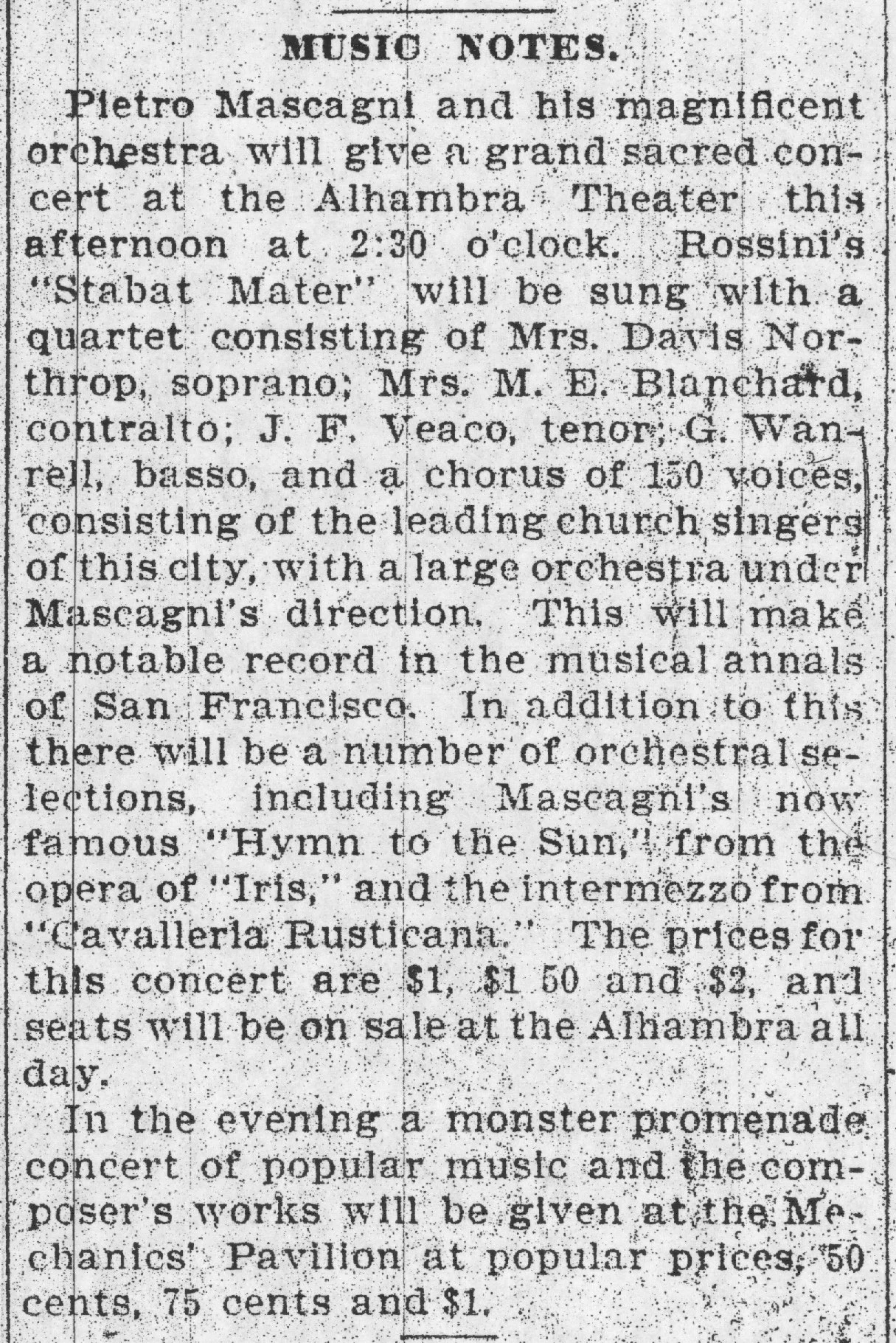
San Francisco Chronicle · February 22, 1903 · 185 words · Original Clipping
Day-of notice for Mascagni’s Sunday doubleheader: the 2:30 p.m. sacred concert featuring Rossini’s Stabat Mater with local soloists and 150 church singers at the Alhambra Theater, followed by an evening popular promenade concert at the Mechanics’ Pavilion.
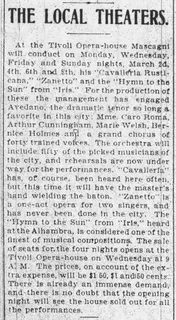
San Francisco Chronicle · February 22, 1903 · 220 words · Original Clipping
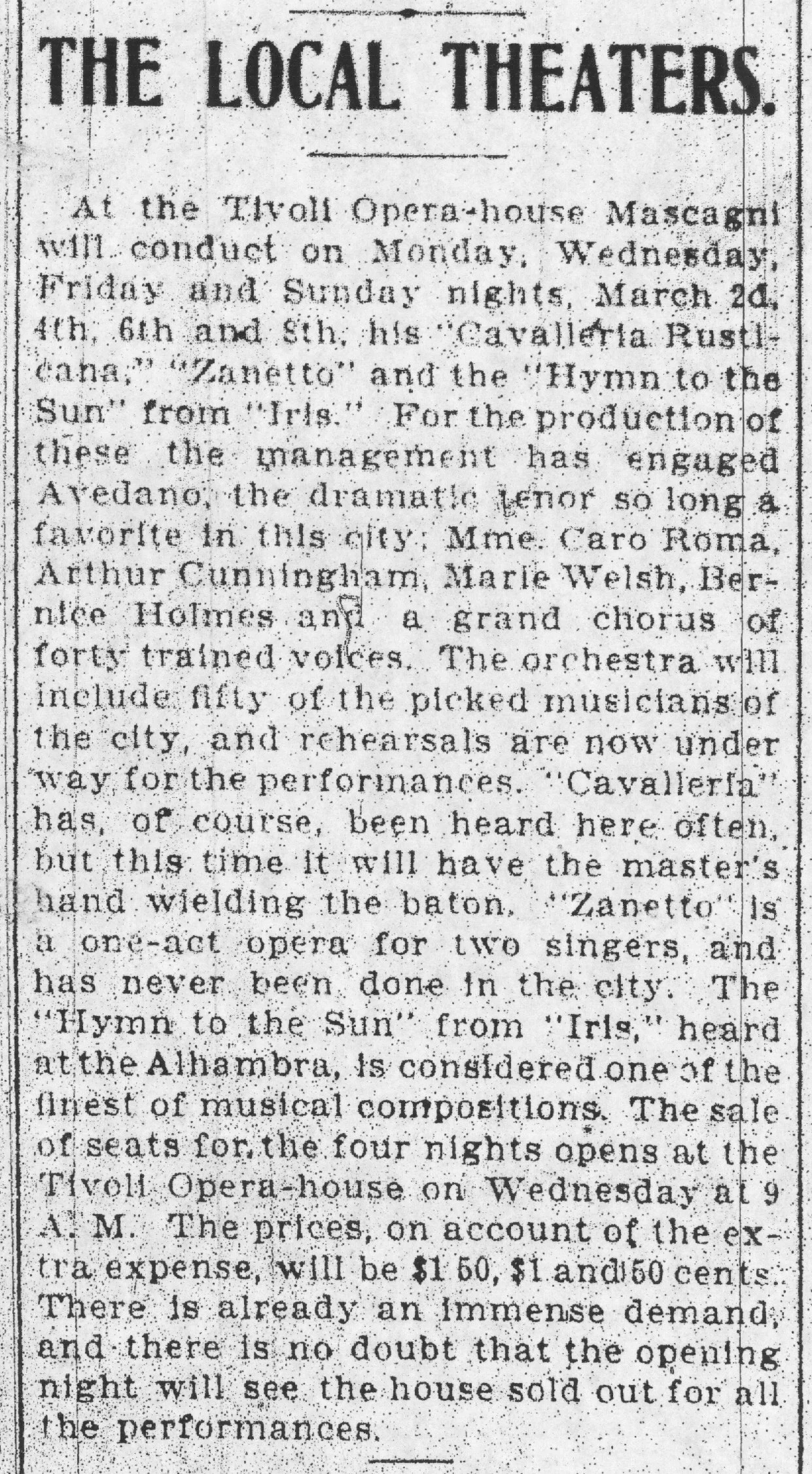
Announces Mascagni’s staged operatic engagement at the Tivoli Opera-House beginning March 2, conducting Cavalleria Rusticana and the Hymn to the Sun from Iris with dramatic tenor Fernando Avedano, soprano Caro Roma, baritone Arthur Cunningham, and a fifty-piece orchestra.
Orchestra and Singers Under His Baton Give the “Stabat Mater”
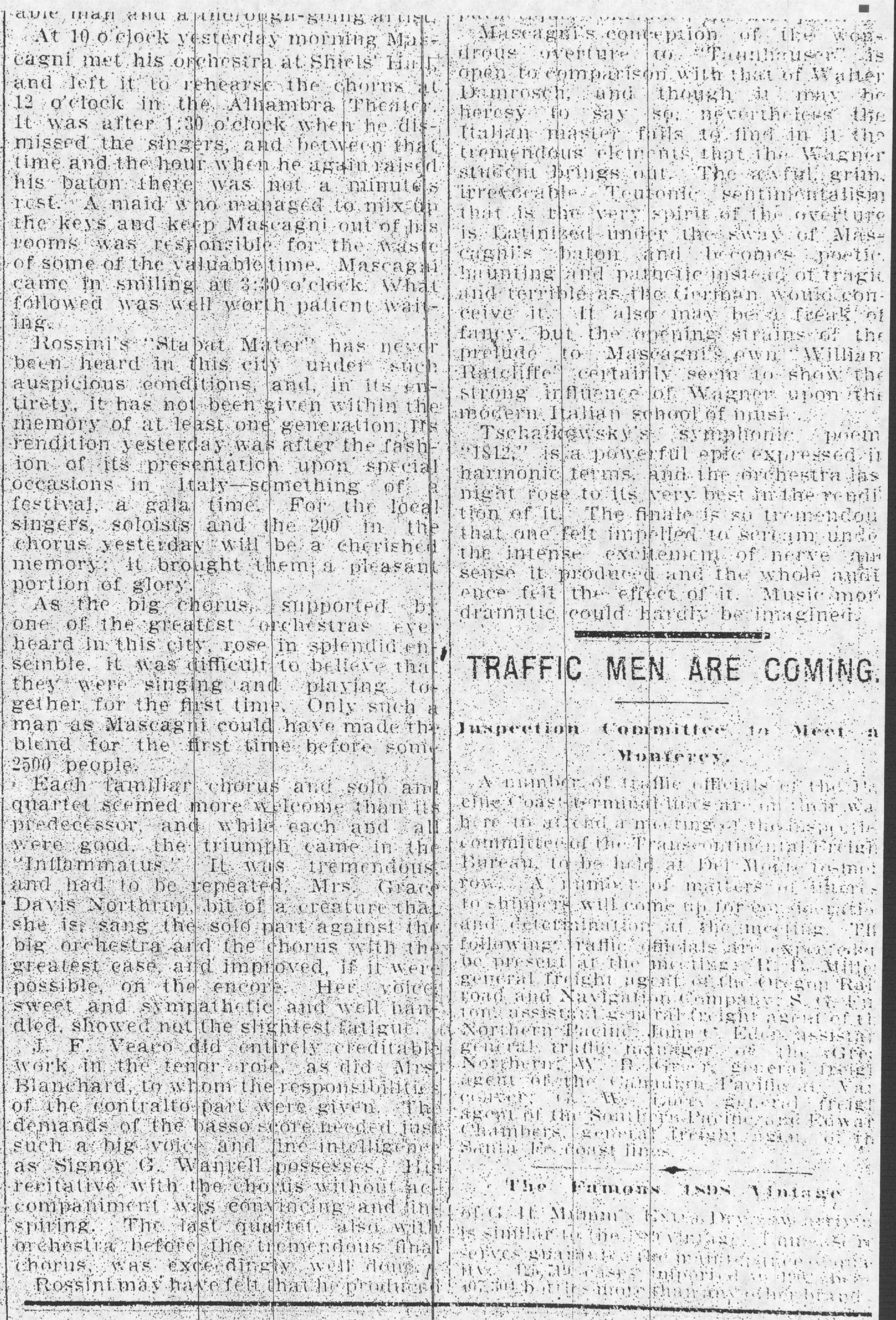
San Francisco Chronicle · February 23, 1903 · 1,075 words · Original Clipping
Detailed review of both Sunday, February 22 concerts — recounting how a locked hotel room delayed the afternoon Stabat Mater by thirty minutes before a triumphant performance with 200 choristers, Chopin’s Marche Funèbre, and Guglielmo Ratcliff, and comparing Mascagni’s “Latinized” Tannhäuser Overture with Walter Damrosch’s.
Signed autograph piano miniature composed by Mascagni in gratitude to San Francisco, with Library of Congress
manuscript scans, modern piano edition, and MP3 recording.
Four-page color newspaper musical supplement published by the San Francisco Examiner featuring piano
excerpts from Act II (“Valley of the Shadow”) and Act IV of Mascagni’s 1902 score to Hall Caine’s play.
5. Chronology of the San Francisco Season (Feb.–Mar. 1903)
Feb 7, 1903
Arrives in San Francisco at 8:25 a.m. from Chicago with his wife Lina at the invitation of local impresario Will L. Greenbaum, determined to remain in America until the Mittenthal lawsuit is resolved.
Feb 8, 1903
The San Francisco Examiner publishes the arrival interview “Pietro Mascagni Wants to Forget” alongside Greenbaum’s opening Alhambra Theater concert announcements in the Chronicle.
Feb 17, 1903
Opening symphonic matinee at the Alhambra Theater (Rossini’s William Tell Overture, Tchaikovsky’s Pathétique Symphony, suites from The Eternal City, Schumann’s Träumerei, Dance of the Dolls, and the Hymn to the Sun from Iris, with the Cavalleria Intermezzo as encore); reviewed the next morning in “Music Lovers Give Honor to Mascagni.”
Feb 19, 1903
Second Alhambra Theater symphonic matinee featuring Wagner’s Meistersinger Prelude, Tannhäuser Overture, and Liebestod, Goldmark’s Second Symphony, The Eternal City, and — by popular demand — the Hymn to the Sun; five hundred admirers line Jones Street afterward.
Feb 20–21, 1903
Composes and signs the piano miniature Un pensiero a San Francisco (“A Thought for San Francisco”) as a tribute to the city, published in facsimile the following day.
Feb 22, 1903
Conducts two packed Sunday concerts: Rossini’s Stabat Mater, Chopin’s Marche Funèbre, and excerpts from Guglielmo Ratcliff before nearly 3,000 listeners at the Alhambra in the afternoon, and a popular promenade concert before 4,000 at the Mechanics’ Pavilion that evening (reviewed Feb. 23).
Feb 25–27, 1903
Honored at banquets at the Palace Hotel with San Francisco’s Italian community and at the Bohemian Club, where he is named an honorary member.
Mar 2–15, 1903
Conducts nine sold-out performances at the Tivoli Opera-House pairing staged Cavalleria Rusticana (with Caro Roma, Fernando Avedano, and Arthur Cunningham) with orchestral excerpts from Guglielmo Ratcliff and The Eternal City and a staged Hymn to the Sun.
Mar 17 & 20, 1903
Conducts a Beethoven and Wagner program (March 17) followed by a grand Testimonial Farewell Concert at the Alhambra Theater (March 20), where Mayor Eugene Schmitz addresses the audience and Mascagni is presented with a commemorative watch and gifts.
Mar 24–27, 1903
Makes his final North American appearance at the Tivoli Opera-House on March 24 in a benefit concert for San Francisco’s Verdi Monument Fund; with the Mittenthal lawsuit settled in his favor, departs San Francisco on March 27 and sails from New York aboard La Savoie on April 2.